PoC to Production in Hours: The 4EverAble2Shell Chain
Hours after a public PoC, the Axis / N-central 4EverAble2Shell chain hit production. Timeline, detection, and patch guidance — no exploit steps.
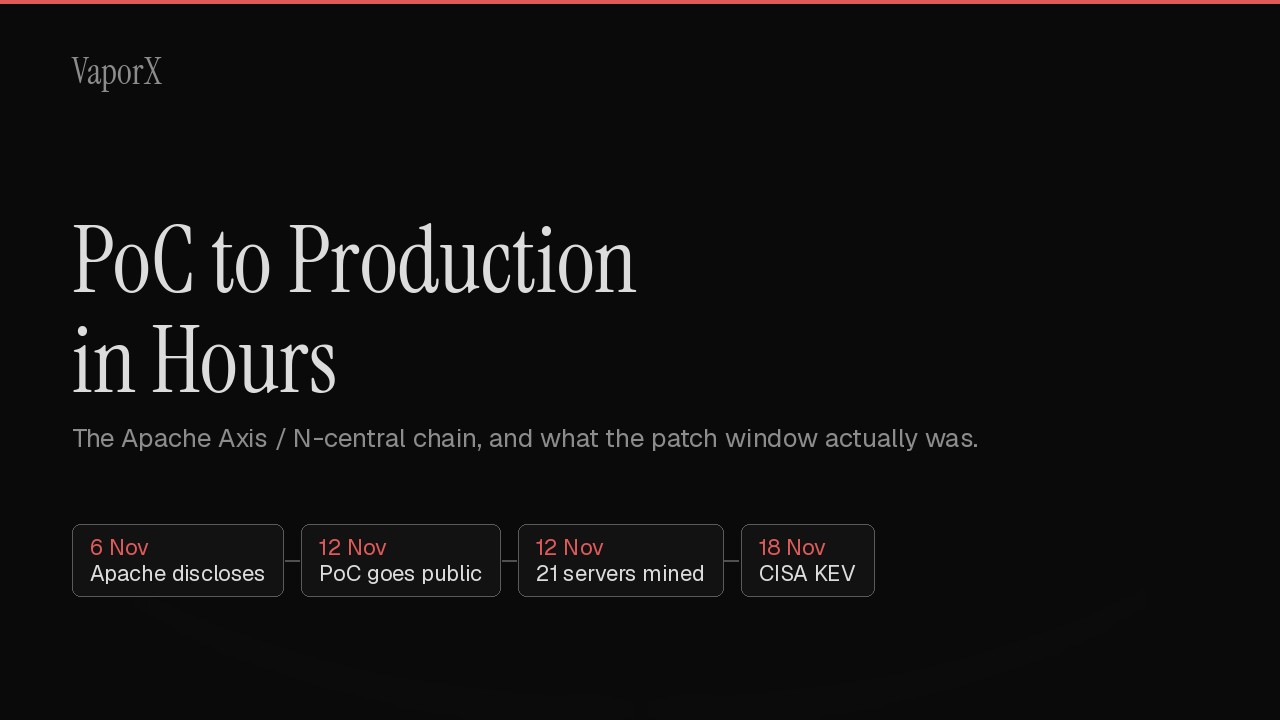
A leftover SOAP library, a public proof-of-concept, and a patch window that did not last the afternoon.
On 6 November, Apache disclosed a critical bug in Axis 1.x, an end-of-life Java SOAP engine. Six days later a proof-of-concept aimed at N-able N-central went public. The same day, researchers watching honeypots and mining pools counted 21 production servers already running a Monero miner, 19 of them on the emergency hotfix N-able had shipped two days earlier. On 18 November, CISA put the Axis flaw in the Known Exploited Vulnerabilities catalog, with a 21 November due date. This post is the timeline, the class of bug, and the defensive work. It is not a reproduction guide. There are no exploit steps and no proof-of-concept code here.
The same November stretch produced another emergency in a management plane you do not get to ignore: Broadcom’s 19 November patch for a vCenter authentication bypass that Mandiant says was exploited as a zero-day from early September. Different product, same shape. If an unauthenticated caller can reach a privileged control service, the rest of the discussion is about how many hours you had.
Key findings
- CVE-2026-90436: Unauthenticated class instantiation via a SOAP fault in Apache Axis 1.x through 1.4. Apache called it critical and does not plan a 1.x release
- 4EverAble2Shell: Public name for a chain that pairs that Axis bug with an N-central privilege escalation, on systems where Legacy API is enabled
- Speed: Huntback reported 21 compromised N-central servers the same day the PoC appeared, 19 already on hotfix 2
- Also hit: Atlassian Confluence Data Center, when “Remote API (XML-RPC & SOAP)” is on. Rapid7 watched a 13 November intrusion move from the Confluence account to a data warehouse and Microsoft 365 in hours
- Related: CVE-2026-123890 in vCenter, patched 19 November in VMSA-2026-0009, exploited earlier as a zero-day
Timeline
All times below are as the vendors and researchers stated them. Where a time is UTC, we keep it as UTC.
- 6 November. Apache discloses CVE-2026-90436 on oss-security: an unauthenticated class-instantiation bug in Axis 1.x through 1.4, severity critical, product already end-of-life. The project does not expect to ship a 1.x fix. Migrate off Axis 1, or rebuild it with the published patch commit.
- 9 November. Atlassian publishes a Confluence Data Center advisory. The same day, N-able says it began responding to a first wave of N-central zero-days that were not responsibly disclosed. N-able took hosted servers offline and recommended that on-premises customers do the same until a hotfix was ready.
- 10 November. N-able ships N-central 2026.4 HF2 (version 2026.4.1.26), addressing the internet-facing, unauthenticated issues from that first wave, and brings hosted servers back. Atlassian’s fixed Confluence release is 9.2.28.
- 12 November. Researcher Sean Bales publicly releases two new exploit chains, reported by BleepingComputer as 4EverAble2Shell and Agent2Shell, tested against the HF2 appliance. 4EverAble2Shell requires N-central’s Legacy API, which N-able says is off by default. N-able restricts some features (including Intune, as a precaution), tells on-premises customers to keep Legacy API disabled, and at that moment says it has seen no compromise with the new flaws.
- 12 November, 08:30 UTC. Previdian and Huntback, as reported by BleepingComputer, see probing against N-central honeypots. Huntback puts the first full-chain attempts at 09:16 UTC.
- 12 November, 12:50 UTC. Huntback reports 21 active miners whose pool identifiers begin with
nc_plus a server IP. All 21 addresses hosted N-central. Nineteen were on 2026.4.1.26, the HF2 build from 10 November. The servers were in the United States, Canada, South Africa, the United Kingdom, Germany, France, and Sweden. The payload was an XMRig miner configured to use about half the CPU cores. - 13 November. Rapid7 MDR detects exploitation against a customer’s Confluence Data Center. Rapid7 also notes N-able reporting in-the-wild exploitation against N-central that strongly correlates to CVE-2026-90436.
- 16 November. N-able releases N-central 2026.4 HF3 (2026.4.1.39), which permanently removes the Legacy API and addresses a further list of CVEs. Rapid7’s later update tells customers to treat HF3 as an emergency install.
- 17 November. A Metasploit module for the Confluence case is published, according to Rapid7. Its existence is part of the clock. We are not describing it.
- 18 November. CISA adds CVE-2026-90436 to the KEV catalog. Date added: 18 November. Due date: 21 November. CWE-470. CISA also flags forensic triage under BOD 26-04.
- 19 November. Broadcom ships VMSA-2026-0009 for CVE-2026-123890 in vCenter. Mandiant publishes that Armory Castle exploited it in early September. CISA adds this CVE to KEV on 20 November, due 23 November.
That is the window. Disclosure on the 6th. A product-specific PoC on the 12th. Production miners before lunchtime UTC the same day, including hosts that had already taken the previous hotfix. KEV four days later.
What CVE-2026-90436 actually is
We will stay with Apache’s own wording, not a recipe.
In the 6 November oss-security advisory, Axis committer Robert Lazarski describes CVE-2026-90436 as unauthenticated remote class instantiation via a SOAP fault. When an inbound fault carries a named exception in its detail, Axis 1.x loads that class. If a string value is also present, it instantiates the class through its string constructor before checking that the result is an AxisFault. Loading the class is already enough to run a static initializer. If a suitable class is on the application’s classpath, that becomes remote code execution.
Two properties make this worse than a normal authenticated SOAP bug. First, Apache says the fault is parsed while the engine is still resolving the target service, before any per-service handler chain runs, so authentication handlers on a service do not protect against it. Second, Axis 1.x is end-of-life. The advisory is marked “UNSUPPORTED WHEN ASSIGNED.” Apache recommends migrating to another SOAP engine, such as Axis 2/Java, or applying the patch commit 41f3b4e8d04e310ca81f86b92630ab2c11d608bd. There will not be a new 1.4.x release.
CISA’s KEV entry describes the same flaw as an unsafe reflection vulnerability (CWE-470). Atlassian, rating the impact on Confluence Data Center, calls it critical at 9.3 under CVSS 4.0. Rapid7 has also referred to a 9.8 figure; we could not confirm that number on CISA’s own KEV record, so we are not treating 9.8 as official.
The important operational fact is not the score. It is that Axis 1.x is a library, not a product you might remember you installed. It shows up inside other Java applications, sometimes behind a checkbox that nobody has looked at in years.
Why N-central’s previous hotfix was not the end of it
N-central is a remote monitoring and management platform. A compromised RMM is not one host. It is a path into the customers that RMM was built to reach. That is why this chain mattered even when the first observed payload was a cryptocurrency miner rather than a ransomware loader.
BleepingComputer’s reporting, citing the public research and then Previdian and Huntback, describes 4EverAble2Shell as a two-stage chain on appliances where Legacy API is enabled: CVE-2026-90436 is used to run commands as the nable service account, and a separate N-central privilege-escalation issue is then used to reach root. We are deliberately not describing that second stage. If you need the mechanical detail, the public reporting is already out there; repeating it here does not help a defender.
Two details from that reporting do help a defender. First, the researcher who published the PoC said it was tested against N-central appliance 2026.4.1.26 HF2. HF2 was a real emergency patch for the first wave. It was not a fix for a Legacy API attack surface that was still present if someone had turned that feature on. Second, Huntback’s 21 confirmed victims included 19 hosts already on that HF2 build. “We patched on the 10th” was not a complete sentence on the 12th.
N-able’s own remediation update is consistent with that picture, even when it uses different names. The 12 November publication is grouped as Legacy API abuse and Agent Impersonation. Legacy API, N-able says, is default off and was kept only for customers who had explicitly enabled it. Agent Impersonation, in N-able’s description, already requires a foothold on an endpoint. HF3, shipped 16 November, permanently removes Legacy API and hardens how agents, probes, and appliances authenticate. Until HF3 is installed, on-premises administrators were told to confirm Legacy API is disabled, even on HF2.
A second chain, Agent2Shell, was disclosed the same day and was described as targeting N-central’s agent path on Windows. We have not independently verified that claim, and N-able’s public write-up does not use that name. Treat it as a second, related exposure from the same disclosure window, and follow the vendor’s agent and probe upgrade guidance rather than a third-party nickname.
Previdian told BleepingComputer that the first post-exploitation fetch they saw went to 157.20.241.16. Rapid7 later listed that address, plus 139.99.69.109 and 79.76.51.56, as IOCs N-able published on 13 November for customers who had not disabled Legacy API. Huntback recommended checking for an unexpected xvd.service systemd unit, miner processes, and files under /tmp/.xvd or /var/tmp/.xvd, and investigating suspicious requests to /dms/services/ServerUI. Root on an RMM is a full compromise of that server. Assume lateral movement into managed tenants until you can show otherwise.
Confluence was in the same blast radius
Axis 1.x is a library. N-central was one place it surfaced. Confluence Data Center was another, and only when Remote API (XML-RPC & SOAP) is enabled.
Atlassian’s advisory (9 November) says versions 1.x through 9.x are affected in that configuration. The setting has been off by default for new installs since 3.0, and the feature was removed in 10.0, so 10.x and Atlassian Cloud are not vulnerable. The fix for remaining 9.x systems is 9.2.28. If you cannot patch immediately, an administrator can clear the Remote API checkbox under General Configuration → Further Configuration; Atlassian says the change takes effect without a restart, though integrations that needed the API will break. The vendor’s own check is to request /plugins/servlet/soap-axis1/confluenceservice-v2 and confirm you get HTTP 403.
Rapid7’s 13 November MDR case is why “off by default” is not the same as “off in production.” Unauthenticated POST requests to that SOAP endpoint returned HTTP 500, and within seconds the Confluence Java process launched Bash and curl as the confluence service account. Rapid7 describes hundreds of commands, access to the MySQL database with Confluence’s own credentials a little over three minutes in, a production cloud data warehouse at roughly four hours, and a Microsoft 365 sign-in as an integration account at about twelve hours, from 192.238.253.176. Other addresses and tunnel hostnames from that incident are in Rapid7’s IOC list. The lesson is not the specific tooling. It is the dwell-time math: a leftover SOAP checkbox became a path out of the wiki and into identity.
A related example: the vCenter authentication bypass
On 19 November, Broadcom released VMSA-2026-0009 for CVE-2026-123890, an authentication bypass in the VMware Directory Service. Broadcom’s position, as reported by BleepingComputer and summarised in CISA’s KEV entry, is that an unauthenticated attacker with network access to a vulnerable vCenter can bypass authentication and gain unauthorised access. Broadcom called it an emergency update, said there are no official workarounds, and noted that network restrictions can only reduce exposure. The flaw is independent of Enhanced Linked Mode.
Mandiant and Google Threat Intelligence Group say the suspected PRC-nexus group Armory Castle (formerly UNC5221) exploited this vulnerability in early September 2026, after first using a BeyondTrust Remote Support zero-day and moving internally. Mandiant’s description of successful exploitation is a session established as administrator@vsphere.local. From there, they documented theft of directory data, creation of an SSO administrator account, and follow-on tooling aimed at SAML token forgery and deeper access into ESXi and guest systems, including Active Directory database files. CISA added CVE-2026-123890 to KEV on 20 November, due 23 November — today, if you are reading this on publish day.
We are not mixing these into one campaign. Armory Castle is not the N-central cryptojacking cluster. The reason it belongs in the same post is the operational rhyme: a privileged management plane, reachable without a valid login, and a patch that has to be treated as an incident trigger, not a Tuesday update. Apply VMSA-2026-0009, then look for evidence of prior compromise, as CISA’s forensic-triage flag is telling you to do.
What to do, in order
- Inventory Axis 1.x. Not just the two products in the headlines. Any Java service that still exposes an Axis 1 SOAP endpoint is in scope. Apache will not ship you a new 1.x package. Migrate, or apply the published patch and follow the product vendor after that.
- N-central. Upgrade on-premises and hosted guidance to 2026.4 HF3 (2026.4.1.39) now. Confirm Legacy API is gone, not merely “we think it was off.” If a server was internet-reachable with Legacy API enabled between 12 November and the HF3 install, treat it as a compromise investigation, not a patch ticket. Hunt the IOCs below, then assume the RMM itself may have been used against managed tenants.
- Confluence Data Center. Patch to 9.2.28 or move to an unaffected 10.x line. If you must buy hours, disable Remote API and confirm the SOAP URL returns 403. Then look at access logs for unauthenticated POSTs to that endpoint, especially those followed by
bashorcurlas the Confluence service account. Cloud is not affected. - vCenter. Apply VMSA-2026-0009. There is no vendor workaround. Restrict who can reach the directory and SSO interfaces, and investigate for activity dating back to early September, not just to the patch date.
- Do not stop at “patched.” CISA’s KEV entries for both CVE-2026-90436 and CVE-2026-123890 carry a forensic-triage expectation. The Confluence case used valid application credentials after the first code execution. The N-central case yielded root. A clean package version does not rewind either of those.
title: Confluence Axis SOAP endpoint errors followed by shell children
id: 3c9e0d41-6b2a-4f11-9a80-axis-confluence-1
status: experimental
logsource:
  product: linux
  category: process_creation
detection:
  parent:
    ParentImage|endswith: '/java'
    ParentCommandLine|contains: 'confluence'
  child:
    Image|endswith:
      - '/bash'
      - '/sh'
      - '/curl'
      - '/wget'
  condition: parent and child
level: high
falsepositives:
  - Unusual but possible in some maintenance scripts. Correlate with POSTs to the SOAP endpoint that returned HTTP 500.
DeviceProcessEvents
| where InitiatingProcessFileName =~ "java"
    and InitiatingProcessCommandLine has "confluence"
| where FileName in~ ("bash", "sh", "curl", "wget", "python", "python3")
| project Timestamp, DeviceName, FileName, ProcessCommandLine,
    InitiatingProcessCommandLine
// Web / proxy logs: unauthenticated hits on the Confluence Axis servlet
DeviceNetworkEvents
| where RemoteUrl has "/plugins/servlet/soap-axis1/"
| project Timestamp, DeviceName, InitiatingProcessFileName, RemoteUrl, RemoteIP
On N-central appliances, prioritize the vendor’s own compromise-assessment guidance, and look for:
- Unexpected requests to
/dms/services/ServerUI - A systemd unit named
xvd.service, miner processes, or files under/tmp/.xvdand/var/tmp/.xvd - Outbound connections to the addresses N-able listed for the 13 November update:
157.20.241.16,139.99.69.109,79.76.51.56
For the Rapid7 Confluence intrusion, start with 192.238.253.176, 5.133.47.243, 163.182.68.109, 104.13.106.166, and the tunnel patterns Rapid7 published (*.trycloudflare.com, a Pinggy hostname, webhook.site). Absence of those addresses does not clear a host.
This is the other half of the November lesson we wrote about in Living Off the Cloud: sometimes the operator hides in a service you already trust, and sometimes they just walk through a leftover interface you forgot was on. In both cases, the useful detections are behavioural, and the useful patches are the ones you treat like an incident.
FAQ
What is CVE-2026-90436?
It is a critical, unauthenticated vulnerability in Apache Axis 1.x through 1.4. A crafted SOAP fault can cause Axis to load and instantiate a class before authentication handlers run. Axis 1 is end-of-life, and Apache does not plan a 1.x release. The official write-up is the 6 November oss-security advisory.
What is 4EverAble2Shell?
It is the public name used for a chain against N-able N-central that combines CVE-2026-90436 with a separate N-central privilege-escalation issue, and that requires the product’s Legacy API to be enabled. Researchers reported in-the-wild use the same day a proof-of-concept was published, including cryptocurrency mining on production servers that were already running hotfix 2.
Why wasn’t N-central hotfix 2 enough?
HF2, shipped on 10 November, addressed internet-facing unauthenticated issues from an earlier disclosure wave. The 12 November chain was tested against that HF2 build and depended on Legacy API still being available if it had been turned on. N-able’s 16 November HF3 permanently removes Legacy API. That is the upgrade to be on.
What should Confluence administrators do?
If you run Confluence Data Center 1.x–9.x, patch to 9.2.28 or a current 10.x release. 10.x and Atlassian Cloud are not affected. If you cannot patch immediately, disable “Remote API (XML-RPC & SOAP)” and confirm the Axis servlet returns HTTP 403. Then review logs and process telemetry for signs of the 13 November-style activity Rapid7 described.
How is the vCenter bypass related?
It is not the same bug or the same actors. CVE-2026-123890 is an authentication bypass in vCenter’s Directory Service, patched on 19 November, and Mandiant says it was exploited as a zero-day from early September by Armory Castle. It is in this post as a same-month example of a management-plane service that must be patched and then forensically reviewed, not as part of the Axis chain.
Will this post include exploit code or reproduction steps?
No. The public proof-of-concept already did the damage this timeline is about. If you administer these products, the useful work is inventory, patching, and compromise assessment.
Sources
- Apache oss-security: CVE-2026-90436
- CISA alert: KEV additions, 18 November 2026
- CISA Known Exploited Vulnerabilities Catalog
- Atlassian: CVE-2026-90436 in Confluence Data Center
- N-able vulnerability remediation update
- N-central 2026.4 HF3 release notes
- Rapid7: exploitation against Confluence Data Center and N-central
- BleepingComputer: 4EverAble2Shell exploited hours after the PoC
- Broadcom VMSA-2026-0009
- Mandiant / GTIG: Armory Castle and vCenter
- BleepingComputer: vCenter zero-day exploited since September
- VaporX: Living Off the Cloud