Living Off the Cloud: APT C2 Hidden in Dropbox, GitHub, and SharePoint
APTs are hiding command-and-control in Dropbox, GitHub, and SharePoint. A pattern read of ShadowCloud, Kimsuky LNKs, and how to hunt it.
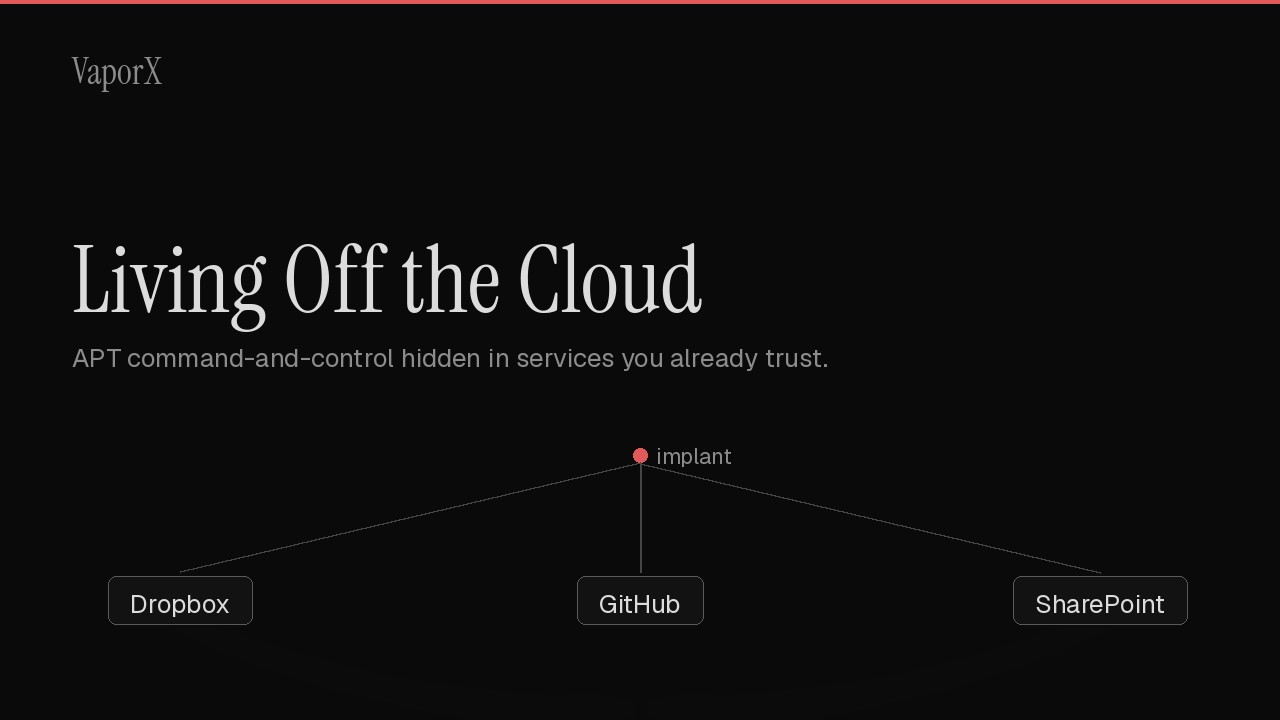
The C2 server is a folder you already allow outbound.
In October we took apart Shedding Skin, a Windows shortcut family that never stood up a domain of its own. It talked to Dropbox. That was not a one-off trick. In the middle of November, public reporting showed the same idea running at APT scale: implants that take orders through GitHub, Microsoft SharePoint, Ably, MEGA, and, still, Dropbox. If your detections start at “unknown domain” or “unknown IP,” this traffic never lights up.
This is a pattern piece, not a new sample dump. We have not detonated these campaigns ourselves. Every technical claim below is drawn from the public write-ups, with links, and tied back to what we already confirmed in Shedding Skin. Where a vendor is inferring rather than proving, we say so.
Key findings
- Pattern: Command-and-control and exfiltration over legitimate cloud APIs, so domain and IP blocking fail
- ShadowCloud: Kaspersky’s GitDoor and GraphDoor hide C2 in GitHub, SharePoint, and Ably after a MeshAgent foothold
- Kimsuky-linked LNKs: Genians and AhnLab describe shortcut lures that still use Dropbox (and MEGA, GitLab) as trusted pipes
- Detection: Hunt the process that calls the cloud API, not the destination. Sigma and KQL below
- ATT&CK: T1102, T1102.002, T1574.002, T1219, T1204.002, T1059.001
The pattern: a folder instead of a server
Living off the cloud is the same move as living off the land, pointed at your SaaS allow-list. The operator does not need a bulletproof domain, a purchased VPS, or a CDN in a friendly jurisdiction. They need an account, a token, and a file or issue the implant already knows how to poll. MITRE tracks the general idea as T1102 (Web Service) and the bidirectional case as T1102.002.
The implant still has to do the boring work: identify the host, upload reconnaissance, download a task, mark that task consumed. In Shedding Skin that state machine was a set of Dropbox path names. In Kaspersky’s GitDoor it is a pair of GitHub repositories. In GraphDoor it is a SharePoint library reached through the Microsoft Graph API. The brand on the TLS certificate changes. The constraint does not: a script host or a sideloaded binary will call a well-known API from a machine that may not even have the official client installed.
That is the hunt. Everything else is costume.
What Shedding Skin already taught us
Build 1 of Shedding Skin used a hard-coded Dropbox OAuth app. The implant refreshed a token, uploaded encrypted reconnaissance to a per-victim folder, downloaded an operator-staged batch file, and renamed that file so it would not run twice. There was no attacker-owned infrastructure anywhere in the chain. Domain and IP pivots were dead on arrival.
We said then: do not block dropboxapi.com. Hunt script hosts calling it on hosts that do not have a Dropbox client. November’s reporting is that sentence, repeated across vendors, clouds, and campaigns.
Kimsuky-linked LNKs are still riding Dropbox
On 16 November, Genians Security Center published an analysis of NodeLinkRAT, a JavaScript implant they observed in a September 2026 spearphish against a seminar attendee in South Korea. The lure impersonated a senior aide in a National Assembly member’s office and used an honorarium form as the hook. The first email had no attachment. After the victim replied to say so, a second mail arrived with a ZIP delivered through a webmail large-attachment feature. Inside it was a shortcut disguised as an HWP document.
The second-stage script, according to Genians, set a scheduled task and polled a public note page (aNotepad) on a 38-minute cycle, executing whatever the operator had posted between two markers. The posted code changed over the collection window: in-memory XenoRAT in June, Dropbox and MEGA collection scripts in mid-September, document theft, and later a Node.js runtime plus the tool Genians named NodeLinkRAT. Because the note page is the tasking channel, a single snapshot of a hash or a C2 address will not describe the campaign.
The Dropbox stage is the part that should feel familiar. On 18 September, Genians decoded three near-identical scripts from the note page. Each used a hard-coded Dropbox app key and refresh token, then uploaded reconnaissance to /[victim identifier]/[internal IP]/[collection time]_info.log. The only material difference between the three blocks was the folder name, which Genians reads as per-victim identifiers. On 28 September the operator rotated Dropbox app keys, which would keep other victims alive if one app was revoked. A 27 September variant swapped Dropbox for MEGA, installing the official MEGAcmd tool if it was missing, uploading, logging out, and deleting the local log.
Genians assesses the activity as Kimsuky with moderate confidence: overlapping account assets, phishing-kit layout, and C2-subnet use with past Kimsuky activity, plus targeting that fits, but no single decisive proof. They are explicit that XenoRAT is open source and that Dropbox is widely abused, so the individual pieces are not enough on their own. We will keep that caveat.
AhnLab, in a 3 November write-up of a separate Kimsuky LNK cluster (KimJongRAT, plus MeshAgent abuse), described a distribution shift that fits the same habit. Malicious shortcuts were being served from GitLab repositories, after earlier activity had used GitHub, and some follow-up file downloads had moved from Google Drive to Dropbox. Some of the files used double extensions such as .pdf.lnk. AhnLab also tied the cluster to a May 2026 case by a reused PowerShell C2 address and MeshAgent configuration, while noting that the DLL-based backdoor’s C2 address had changed.
Two vendors, two clusters, one lesson: the lure can be a shortcut, the staging site can move from GitHub to GitLab, and the exfil pipe can rotate from Drive to Dropbox to MEGA without the operator ever buying a server. Static IOCs rot. The cloud-API behaviour does not.
Operation ShadowCloud: GitHub and SharePoint as the C2 fabric
On 17 November, Kaspersky’s GReAT team published Operation ShadowCloud, part 1 and part 2, with a matching press brief. They describe an active cyber-espionage campaign, identified in early 2026, that drops two previously undocumented backdoors — GitDoor and GraphDoor — and hides their command-and-control behind Microsoft SharePoint, GitHub, and Ably. Victims were found in Asia and Africa, primarily in the government sector. The press brief also names Southeast Asia, Africa, and Central Asia.
A MeshAgent foothold, then a sideload
Kaspersky recovered two instances of the MeshCentral Agent inside a Taiwanese organization (they publish the agent MD5 as 74b025084026d8d9a64661bf995d835b). MeshCentral is a legitimate web-based remote-management tool. The exact initial access that put the agent there is unknown; Kaspersky says the evidence points to reuse of a prior infection already on the network. Once the agent was talking to a hard-coded server, it was used to drop three things: a legitimate binary for DLL sideloading, a malicious loader DLL, and an encrypted payload. That is T1574.002 (DLL Side-Loading) plus T1219 (Remote Access Software), and it is the same legitimate-tool habit AhnLab reported in the Kimsuky MeshAgent cases.
The two backdoors share a modular design: they can fetch plug-ins on demand and inject shellcode in memory. Kaspersky also describes a modified Erfrp client and Ably messaging plug-ins used to proxy traffic between infected hosts and the operators.
GitDoor talks to GitHub
GitDoor decrypts a repository URL, a personal access token, a User-Agent, and the headers it needs, then uses two repositories: one as a drop point for commands and plug-ins, and one to upload victim data and command results. Kaspersky published the paths /repos/LatonyCharnleyaW/Havo and /repos/LatonyCharnleyaW/Trix. Uploaded files are given names that look like JavaScript assets, including source-map style suffixes, with extensions that encode the output type (for example .js.kmap for keylogger output). The payload is AES-encrypted and wrapped again before upload. Kaspersky also saw GitDoor sending data to Ably, not only to GitHub.
If you only watch for odd domains, this is an HTTPS session to api.github.com with a token. It will look like a developer tool. It should not look like a developer tool when the process is a sideloaded javaw.exe, start.exe, pythonw.exe, or zoomit.exe — the legitimate binaries Kaspersky lists as loaders in this campaign.
GraphDoor talks to SharePoint
GraphDoor opens a named pipe, stages itself under C:\ProgramData\Intel_Log\<random-GUID>, and gathers host information (adapters, OS version, public and private IP, user, host name, process list, and a generated GUID). It then opens TLS to login.microsoftonline.com and authenticates as a malicious application registration — not as a user — using a hard-coded client ID and secret. With the access token it speaks to graph.microsoft.com, creating a file named main.%victim-unique-code%.js.map in a SharePoint document library and later pulling plug-in modules (scr.ts for screenshots, pr.ts for process listing, kl.ts for keylogging, plus move and proxy modules, including Ably channels).
Kaspersky published the SharePoint site they observed (buildersemp.sharepoint.com) and the Graph request shape, including a JSON body with the message commit from INSOMNIA. Treat those as already-public indicators from the report, not as a complete picture of every deployment. The durable signal is a non-Office process authenticating to login.microsoftonline.com and writing decoy-looking files to Graph.
Capabilities reported across the operation include keylogging, screenshots, file operations, command execution, service and firewall changes, credential theft from memory, and a search for WhatsApp database decryption keys. That last item comes from the press brief.
Attribution: overlap, not a name
Kaspersky is careful here, and so are we. In part 2 they write that they lack sufficient information to attribute the activity to a specific group. They did see overlaps with the Chinese-speaking groups FamousSparrow and CopperTurtle: on several victim systems, those groups shared staging directories with GitDoor, and their implants were deployed within a one-day window of it. They treat that as a suggestion that a Chinese-speaking group may be developing or using GitDoor and GraphDoor, not as proof. The press brief’s “possible links” language is the same finding, shortened.
A related hide, not the same pipe
The same week, on 16 November, Unit 42 described a separate espionage cluster (TGR-STA-0049, also tracked as REF7707, Earth Alux, and Ink Dragon) targeting Southeast Asian government entities with custom RATs they name PerfectPioneer and KUKURAT. The C2 hide there is not a SaaS folder. It is early use of HTTP/3 over QUIC, which can slip past inspections that still assume C2 is a TCP conversation.
It is a different campaign and a different channel. We mention it because the defender’s problem is the same: the traffic is designed to look like something you already allow. Cloud APIs are one version of that. A modern, allowed web protocol is another. If you only model “bad domains,” both will pass.
The same November window also produced a reminder that when a leftover library and a public proof-of-concept collide, the patch window can collapse to hours. That story is in PoC to Production in Hours: The 4EverAble2Shell Chain.
What to hunt (and what not to block)
Do not blanket-block Dropbox, GitHub, SharePoint, or MEGA. You will punish the business and miss the next rotation. Hunt the caller.
The highest-value questions are simple:
- Is a script host,
curl,cmd,wscript, or a sideloaded binary callingapi.dropboxapi.com,content.dropboxapi.com,api.github.com,login.microsoftonline.com,graph.microsoft.com, or Ably, on a host that does not have the matching official client? - Did MeshCentral / MeshAgent appear where it is not an approved remote-management tool? Kaspersky and AhnLab both saw it used as a foothold or follow-on.
- Did
MEGAcmdorMEGAcmdServer.exeappear under%LOCALAPPDATA%\MEGAcmdon a machine that does not use MEGA? Genians calls that a clear lead. - Did a
.lnkjust launchcmdor PowerShell, especially from a ZIP, a desktop of a freshly received “document,” or a file with a double extension?
title: Script host or curl talking to cloud APIs
id: 8f3c1b20-a7d4-4e6b-9c11-living-off-cloud-1
status: experimental
logsource:
  product: windows
  category: network_connection
detection:
  process:
    Image|endswith:
      - '\powershell.exe'
      - '\pwsh.exe'
      - '\wscript.exe'
      - '\cscript.exe'
      - '\cmd.exe'
      - '\curl.exe'
      - '\mshta.exe'
  dest:
    DestinationHostname|contains:
      - 'api.dropboxapi.com'
      - 'content.dropboxapi.com'
      - 'api.github.com'
      - 'graph.microsoft.com'
      - 'login.microsoftonline.com'
      - 'ably.com'
      - 'ably.io'
      - 'mega.nz'
  condition: process and dest
level: high
falsepositives:
  - Rare legitimate automation. Tune with a software-inventory exception for official clients.
DeviceNetworkEvents
| where InitiatingProcessFileName in~(
    "powershell.exe", "pwsh.exe", "wscript.exe", "cscript.exe",
    "cmd.exe", "curl.exe", "mshta.exe")
| where RemoteUrl has_any (
    "api.dropboxapi.com", "content.dropboxapi.com",
    "api.github.com", "graph.microsoft.com",
    "login.microsoftonline.com", "ably.com", "ably.io", "mega.nz")
| project Timestamp, DeviceName, InitiatingProcessFileName,
    InitiatingProcessCommandLine, RemoteUrl, RemoteIP
A second, tighter hunt is software-inventory correlation: the official Dropbox, GitHub, or OneDrive/Office client is absent, but a script host still called the API. That is the same control we recommended for Shedding Skin, widened to the rest of the allow-list. Pair it with PowerShell Script Block Logging (event 4104), child-process telemetry for LNK-to-interpreter chains, and alerts for unexpected MeshAgent or MEGAcmd installs.
If you already run the behavioural logic we described as crazy_lady in the LNK post, this is the cloud-API primitive from that set, applied to more destinations. The actor can change the folder name, the app key, the note page, and the repository. They cannot stop the implant from talking to a cloud API.
FAQ
What does “living off the cloud” mean in APT malware?
It means the malware uses legitimate cloud or SaaS services — Dropbox, GitHub, SharePoint, MEGA, public note pages, or messaging APIs such as Ably — as command-and-control or exfiltration channels, so the traffic looks like ordinary business use and cannot be stopped by blocking an attacker-owned domain.
How did the Shedding Skin LNK family use Dropbox as C2?
The PowerShell implant used a hard-coded OAuth refresh token, uploaded encrypted reconnaissance to a per-victim folder, downloaded a staged batch file, and renamed it so the task would not re-run. There were no attacker-owned servers. The full chain is in Shedding Skin: LNK Malware Analysis.
How do GitDoor and GraphDoor hide their C2?
According to Kaspersky, GitDoor uses two GitHub repositories (one for commands, one for results) with a hard-coded personal access token and file names that mimic JavaScript assets. GraphDoor authenticates to Microsoft as an application, then uses the Graph API to write and read files in a SharePoint library, including plug-ins for keylogging, screenshots, and process listing.
Are these campaigns all the same threat group?
No. Shedding Skin was our own analysis of a Dropbox-C2 LNK family, with TTP overlap that we did not treat as attribution. Genians assesses the NodeLinkRAT spearphish as Kimsuky with moderate confidence. AhnLab attributes a separate November LNK/KimJongRAT cluster to Kimsuky. Kaspersky does not definitively attribute ShadowCloud, and only notes overlaps with FamousSparrow and CopperTurtle. Treat them as a shared technique, not a single actor.
Why doesn’t blocking Dropbox or GitHub stop this?
Because those destinations are legitimate, widely used, and easy for an operator to rotate (a new app, a new repository, a new SharePoint site, or a jump to MEGA). Genians’ advice, which we agree with, is to correlate the process, command line, file path, and API usage rather than blocking the service.
Which MITRE ATT&CK techniques apply?
The core technique is T1102 / T1102.002 (web service as C2). Around it: T1204.002 (malicious file, for LNK lures), T1059.001 (PowerShell), T1053.005 (scheduled task), T1574.002 (DLL sideloading), T1219 (remote access software, MeshAgent), T1027 (obfuscation), and T1105 (ingress tool transfer via trusted services).
Sources
- Kaspersky press brief: Operation ShadowCloud
- Securelist part 1: GitDoor and initial infection
- Securelist part 2: GraphDoor, plug-ins, and attribution
- Genians: NodeLinkRAT and public-note / Dropbox C2
- AhnLab: Kimsuky LNK lures, GitLab distribution, Dropbox staging
- Unit 42: HTTP/3 RATs targeting Southeast Asian governments
- VaporX: Shedding Skin: LNK Malware Analysis
- MITRE ATT&CK T1102