Unlocking Cars With a Radio: My SDR Keyless-Entry Research
How I used a HackRF and GNU Radio to capture and replay car key-fob signals, which cars fell to it, and the simple fix every car should already have.
Back in 2018-19 I spent a stretch of nights in a parking lot with a laptop, a little orange radio board, and a car key. By the end of it I could unlock cars I had permission to test without ever touching their keys. I wrote it up as a paper, Cyber Attacks on Smart Cars using SDR, published in IRJET (Volume 6, Issue 12, Dec 2019). This post is the human version of that paper, plus the hands-on work that lives in my Car-Hacking repo.
A quick, important note before anything else: this was controlled research on vehicles I was allowed to test, done to show a real weakness so it can be fixed. Don’t do this to cars you don’t own. It’s illegal, and that’s not the point.
How keyless entry actually works
The old way to unlock a car was boring and safe: a metal key in a metal lock. Keyless fobs traded that for convenience. Press the button and the fob transmits a short burst of radio at a specific frequency. If the car hears a burst it recognizes, the doors unlock.
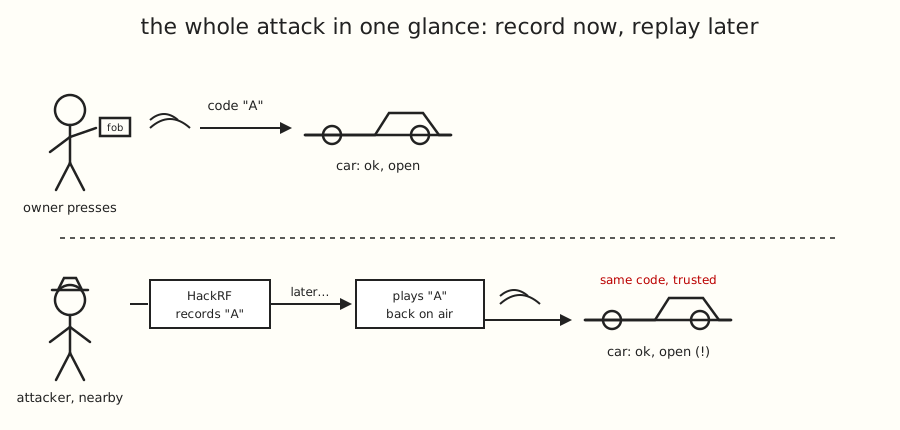
In my testing that frequency sat around 433.9 MHz, a common band for key fobs. And here’s the catch that makes the whole attack possible: on the cars I looked at, the fob sent essentially the same code every time. If the code never changes, then anything that can record radio and play it back can impersonate the key.
The whole attack fits in one picture: record the owner’s press, then play it back later.
The gear: SDR, GNU Radio, and a HackRF
Software-Defined Radio (SDR) is the idea that a radio can be defined in software instead of fixed hardware. Instead of a circuit built to do one thing, you get a general-purpose radio and write the logic.
I used two pieces:
- GNU Radio Companion, a visual toolkit where you wire up “blocks” into a flowgraph to process radio signals.
- A HackRF from Great Scott Gadgets, the actual radio hardware that listens and transmits, connected to the laptop over USB.
Together they let me treat a car key’s signal like any other data: capture it, look at it, and send it back.
Step one: capturing the key
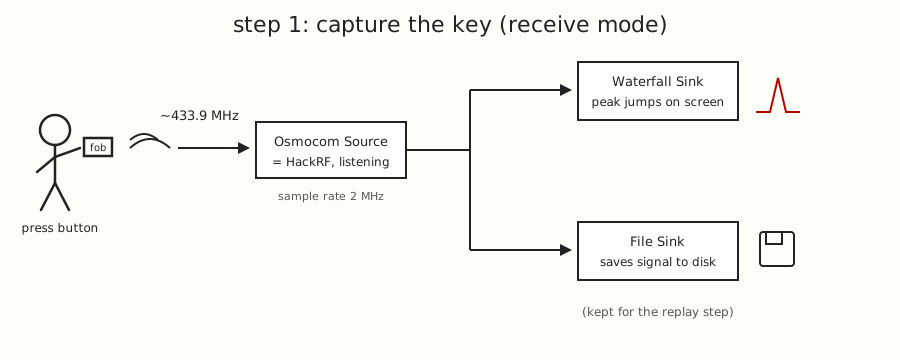
The capture flowgraph was simple. The important blocks:
Osmocom Source   ->  switches the HackRF into receive mode over USB
  center freq:   ~433.9 MHz   (the key fob band)
  sample rate:   2 MHz
QT GUI Waterfall Sink  ->  live visual of the spectrum
File Sink        ->  writes the captured signal to disk
The Osmocom Source is the abstraction layer that talks to the HackRF and tells it to start receiving. The Waterfall Sink draws the spectrum in real time, so when I pressed the fob button, a bright peak jumped up at the key’s frequency. That peak is the key’s transmission. The file sink saved the raw signal so I could replay it later.
Step two: replaying it at the car
Replay is capture in reverse. The flowgraph reads the saved signal back from the file and pushes it out through the HackRF, with a Throttle block to emit it at a steady, repeated rate so it cleanly matches the frequency the car expects.
File Source -> Throttle -> Osmocom Sink (HackRF, transmit)
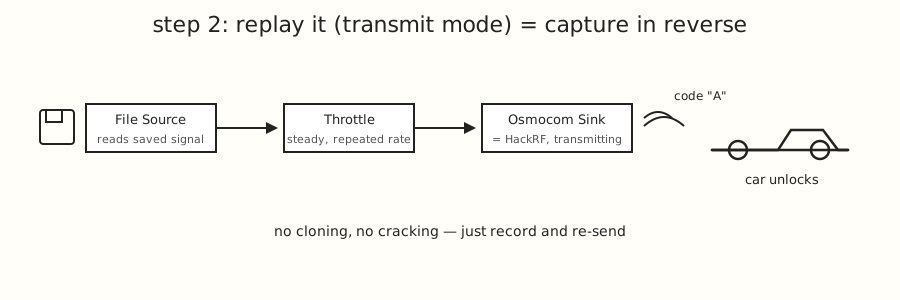
Point the radio at the car, run the graph, and the recorded “unlock” plays back on the air. The car hears a code it trusts and opens. That’s a replay attack: no cloning, no cracking, just record and re-send. The same approach extends to man-in-the-middle (sitting between fob and car) and, with enough noise on the band, denial of service by jamming the fob so the real key stops working.
Which cars fell to it
The formal results in the paper were on three cars, with the Indian Honda City i-Vtec as the main test subject, plus the Toyota Innova Crysta and the Maruti Wagon R. On all three, capture-and-replay worked.
I also ran the same attack against a 2014 Hyundai Xcent. The capture and replay flowgraphs for it (xcentcap.grc and xcentreplay.grc) are in the repo alongside the Honda and Wagon R graphs. Same method, same result.
Why it worked, and the fix
None of this is clever cryptography on my end. It worked because the fobs used fixed codes. A code that never changes can always be replayed.
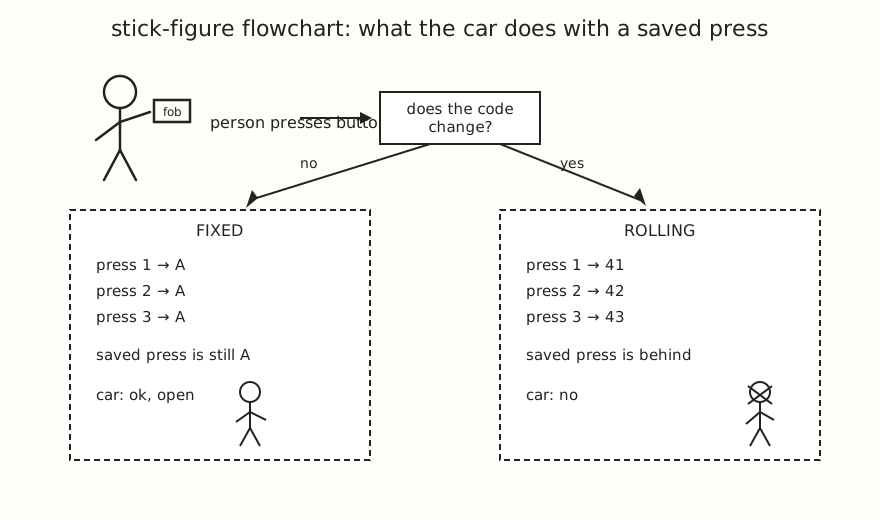
The fix has existed for decades, and good cars already use it:
- Rolling codes (hopping codes). The fob and car share a cryptographically secure sequence. Every button press sends the next code, and the car accepts only codes ahead of the last one it saw (typically within a window of about 256, in case a few presses happen out of range). A replayed old code is simply rejected.
- KeeLoq. A classic code-hopping cipher: it encrypts a 32-bit block to produce a 32-bit hopping code (with a 32-bit initialization vector XORed in), combined with a fixed serial-number portion. Every press produces a different transmission, so a recording is useless a moment later.
The threat model is worth stating plainly. An attacker who owns the fob’s radio link can unlock, steal, track, lock out a key, try to brute-force or clone the fob, or jam its signal. Rolling codes shut down the easy end of that list. My conclusion in the paper was blunt: every car should at least implement a rolling-code mechanism. In 2019 some still didn’t.
Takeaways
The lesson that stuck with me: convenience features quietly become attack surface. A key fob feels like a small thing, but it’s a radio protocol, and radio protocols need the same rigor as anything else. A fixed code is a password you broadcast to everyone nearby.
If you want the formal details, read the full paper. If you want the actual GNU Radio flowgraphs and code, they’re in the Car-Hacking repo. Questions or corrections, find me on X.